History of the Norwich Golf Club
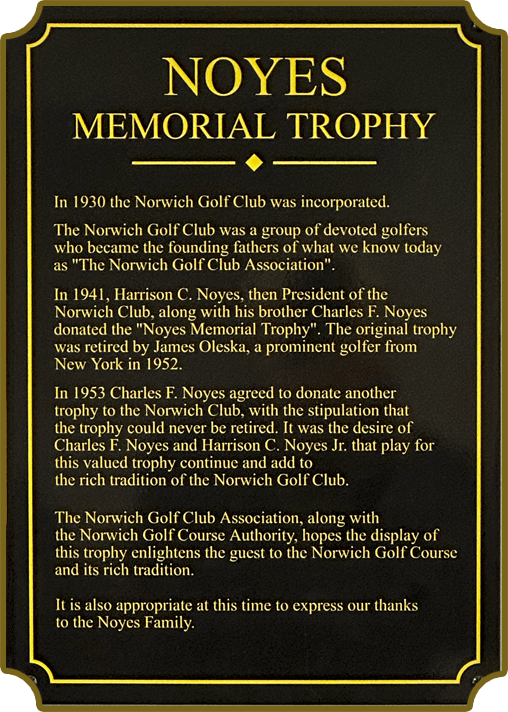
The Norwich Invitational Golf Tournament has been played at the Norwich Golf Course since 1926
Golfers come from all walks of life, both young and old. Most reside in Southeast Connecticut, but many also come from other states to compete for the prestigious Noyes Memorial Trophy.
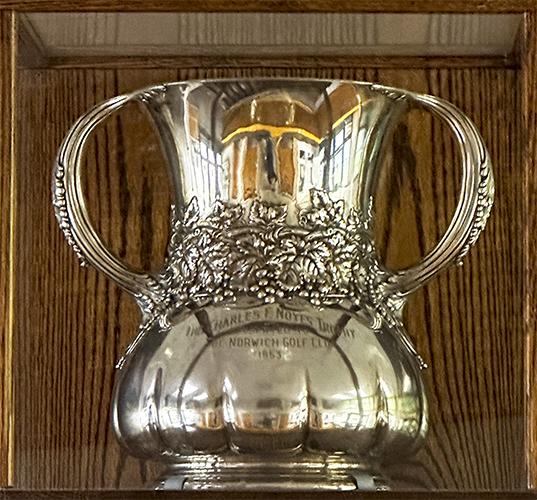
The Norwich Invitational was instituted only a year after the first matches were played at the course. The photo shows a replica of the original trophy.
Since 1926, golfers from throughout New England have been coming to the Norwich Golf Club during the third weekend in July to participate in the Noyes Memorial Golf Tournament. The tournament, known today as the Norwich Invitational, was the only true match-play tournament in Connecticut for many years, aside from the Connecticut Amateur.
The tournament began in 1926, when Charles Noyes of Brooklyn, N.Y., dedicated a silver cup in his mother’s name to honor the game of golf. The first tournament was played the last weekend in June, and only 30 players competed due to inclement weather. Sam Wilcox of Norwich was the medalist with “a fine 80” over the rain-soaked layout. During the early years of the tournament, a qualifying round was held on Thursday, match play on Friday and Saturday, and a 36-hole medal play championship on Sunday. W. K. Lanman of Columbus, Ohio, became the first champion, defeating Wilcox 160-162.
Many of the finest amateur and collegiate golfers competed in the early years of the tournament. The most dominant player throughout this period was Bobby Grant of Wethersfield. He first competed in 1930, when he was both the medalist and the tournament champion. He was a medalist again in 1931, 1935, and 1938, a winner in 1933, and a runner-up in 1935. Another early star of the tournament was Burt Resnick of New Haven, Captain of the Yale University Golf Team, who, in five years of competition from 1931 to 1935, was the winner twice and the runner-up three times.
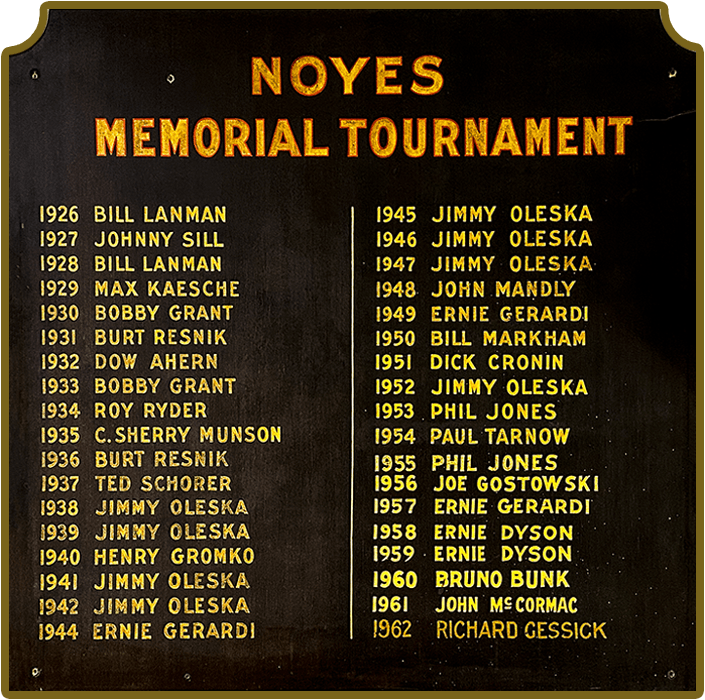
Local players of note during these years included Sam Wilcox, David Morton, Jack Skelly, Ed McKay, Myles Standish, Harold Hull, Snooks Gromko, and Bobby Patrick. Dow Ahern of Willimantic, who first competed as a 16-year-old in 1927, won in both 1932 and 1933. (NOTE: The board shown in the photo incorrectly identifies Bobby Grant as the 1933 winner. Dow Ahern won in 1933.)
Throughout the 1930’s, the tournament grew in stature and prestige. The number of players increased to an impressive 116 in 1934, and the caliber of competition escalated during the mid-30s. The 1934 champion, Roy Ryden, traveled all the way from the University of California to compete in the tournament.
In 1937, Ernie Gerardi of Putnam broke the course record with a 67 in the qualifying round. Other winners during these years were C. Sherry Munson of Yale in 1935 and Ted Schorer of Wethersfield in 1937.
1938 was the first appearance in the tournament of the man who would dominate it over the next 15 years. Jimmy Oleska, a policeman from Brooklyn, N. Y., posted eight victories between 1938 and 1952.
In 1938, Oleska defeated another New Yorker, Gil Smith, a fireman from Staten Island, on the 38th hole. Smith holds the record for longevity in the tournament. He first competed in 1927 at the age of 13 and continued to compete in the tournament until at least 1982. In fact, Smith, at 68, qualified for the championship flight in 1982. He won his first match before being beaten in the quarter-finals.
In 1926, the tournament committee decided that to take permanent possession of the Noyes Memorial Trophy, a player must win the tournament three times. Dow Ahern, a two-time winner, was never able to win the elusive third title. In 1939, Oleska gained his second leg on the trophy with a hard-earned 1-up victory over local hero Bobby Patrick.
But in 1940, Henry “Snooks” Gromko made history by becoming the first Norwich Golf Club member to win the tournament. Gromko, a fine local player and six-time club champion, defeated Oleska 5-and-4.
In 1941, Oleska came to Norwich prepared to win his third title. On the previous Tuesday, he had won the Long Island Amateur, and by Friday, he was at the top of his game. A qualifying score of 71 and easy victories in his first three matches put Oleska in the finals against his conqueror the previous year, Snoocks Gromko. But Gromko proved to be no match for the Brooklynite as Oleska won the first six holes and cruised to a 7-and-6 victory.
For the first time since the inception of the tournament in 1926, the Noyes Memorial Trophy had been retired. Legend has it that Oleska had the sterling silver cup melted down to pay his son’s tuition at the University of Notre Dame. The cup itself was so valuable that the tournament committee decided that in future years, a player must win the tournament five times before it could be retired.
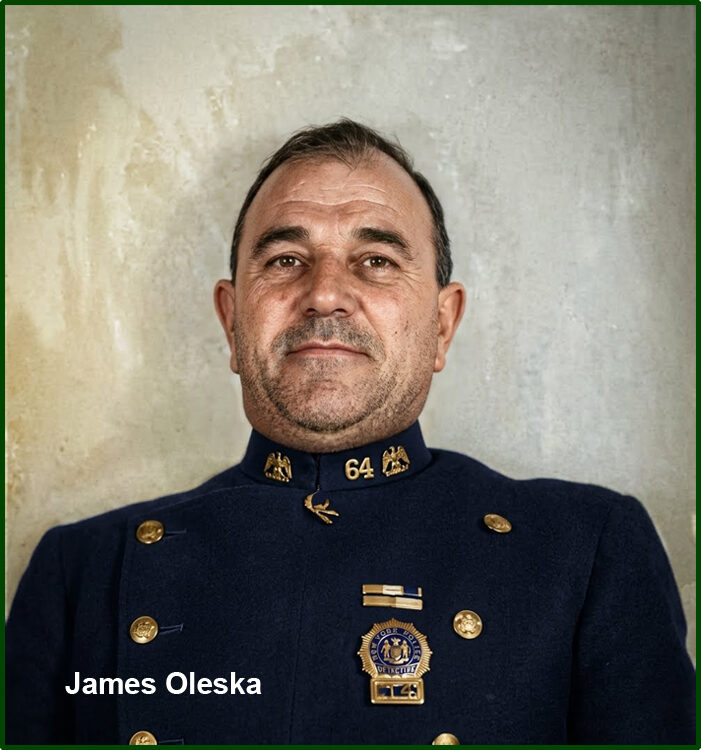
WHO WAS JIMMY OLESKA??
James “Jimmy” Oleska was a New York City Police Department detective with a passion for golf. Detective Oleska was commonly referred to as the “Golfing Detective” and “Sherlock Holmes” by newspapers in the 1940’s. James, who uniquely played golf cross-handed. He competed in New York and throughout New England from the late 1930s to the early 1950s.
Jimmy has held the record for winning the Noyes Memorial Tournament more than anyone else at Norwich Golf Club since 1952. He captured the Noyes Memorial Trophy eight times. Retiring the trophy twice for winning the event three years in a row. For this feat, James was made an Honorary Lifetime Member of the Norwich Country Club.
In 1942, the tournament was shortened to three days because of the war effort. The new format had qualifying on Friday and an 18-hole final on Sunday afternoon. Change in format or not, Oleska could not be stopped. He defeated Ernie Gerardi of Putnam 1-up for his fourth victory. One of the more famous competitors in 1942 was Ted Bishop of Woodland Country Club, in Brooklawn, Massachusetts, who copped medalist honors with a 71. Later that summer, Bishop won the New England Amateur Championship, and in 1946, he won the USGA National Amateur Championship at Baltusrol Country Club.
Oleska’s pursuit of another cup was delayed for the next two years, as the tournament was not played in 1943 due to the war. He did not compete in 1944 due to illness.
Although the absence of Oleska disheartened his tremendous local following, the 1944 tournament marked Ernie Gerardi’s first victory, a fine player from Putnam. Throughout his career, Gerardi would win the tournament three times and be runner-up twice.
Oleska returned to his winning ways again in 1945 with a 1-up victory over Eddie Aldrich of Wethersfield. A 15-foot birdie putt on 18 proved to be the difference. 1946 was no different as Oleska won his sixth title and third leg on the cup with a 4-3 defeat of Felice Torza of Wethersfield.
In 1947, one of the finest fields ever to grace the tournament teed it up on Friday. After qualifying, nine players were tied at 75 for the last four spots in the championship flight. Fighting the blistering heat of Saturday, four of the finest players in the region emerged victoriously. Six-time winner Oleska was pitted against two-time winner Bobby Grant. On Sunday morning, in one of the most demanding matches in the history of the tournament, Oleska defeated Grant after seven sudden-death holes.
In the other semifinal match, Stan Koslowskl, Rhode Island State Amateur Champion, outlasted Holly Mandly, Connecticut Amateur Champion, 3-and-2. With over 300 spectators looking on, Oleska won his 7th title with an easy 6-and-5 victory over Koslowski.
Oleska now needed one more victory to retire the trophy again, but he was to be denied time and time again over the next few years. In 1948, John Mandly of Rockledge defeated Norwich’s Bobby Patrick 3-and-2. (Oleska lost in the quarter-finals).
In 1949, Ernie Gerardi won for the second time with a 2-and-1 victory over Knobby Walsh of Edgewood. (Oleska again lost in the quarter-finals). 150 saw Connecticut Amateur Champion, Bill Markham of Wethersfield, start strong with a qualifying 68. He was never in doubt, as he beat Gerardi 3-and-2. In 1951, Dick Cronin of Wethersfield defeated Bud Hurlbut of Edgewood 2-and-1.
Oleska was not to be denied in 1952. He defeated Don Hoenig, a future New England Amateur Champ and outstanding area professional, 2-and-1, for his eighth victory in 13 tries and permanent possession of the cup for a second time. He was never to win the tournament again, but his efforts were rewarded in 1954 with an “Honorary Life Membership” to the Norwich Golf Club.
In later years, Oleska, who, oddly enough, played cross-handed, was asked why he used such an unorthodox method. He stated, “Because it feels good.” When further asked if he could swing with the contemporary grip, he simply dropped a ball on the back tee of the old 11th hole and drilled a 4-iron to within 10 feet. Oleska was truly an amazing man!
Throughout the remainder of the 1950’s, golfers continued to flock to Norwich during the third weekend of July. In 1954, a record 147 golfers entered the tournament.
In 1953, Phil Jones of Stonington, an outstanding athlete at the University of Connecticut, won the first of his two titles. Jones, who served as the head professional at Shennecossett, won again in 1955, defeating Jim Christina of Norwich in the finals.
Other winners during this era were Paul Tarnow of the Coast Guard in 1954, Joe Gostowski of Meriden in 1956, and Ernie Gerardi (his 3rd title) in 1957. Local golfers who challenged during this time were Norm Zaremba, Charlie Piechowski, Steve Shaffhauser, John Caruso, and Harold Lucas.
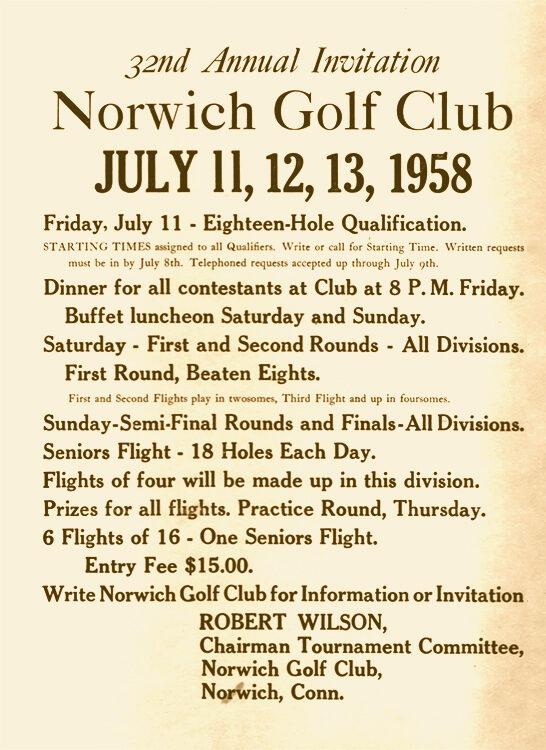
For 16 years, an affable gentleman from The Farms in Wallingford, Ernie Dyson, had been competing in the Invitation with no success, but 1958 proved to be his year as he earned a hard-fought victory over Bruno Bunk of Hubbard Heights 1-up,19 holes. Again, in 1959, Dyson was on the mark as he breezed through his four matches. In the finals, Dyson showed uncanny accuracy with his irons, resulting in a 5-and-4 victory over the longer-hitting Hank Budney of Shennecossett. One of the highlights of the 1959 tourney was a course record 30 on the back side by Romeo Urso of Hubbard Heights. Urso carded birdies on 11, 12, 14, 15, and 16 en route to his fine round of 70.
The 1958 runner-up, Bruno Bunk, was finally victorious in 1960. Spirited by a dramatic 2-and-1 victory over two-time defending champion Ernie Dyson, Bunk held off the charge of Jack Miekle of Willimantic for a 1-up win over 19 holes.
The tournament was played again in the blistering heat in 1961. Rocco Del Piorre was as hot as the weather with a 69 qualifying score, but the man of the hour turned out to be a soft-spoken 24-year-old from Putnam, John McCormac. In the semifinals, McCormac topped Tom Nettleblatt of Torrington to set up his final match with Norwich Club Champion, Charlie Piechowski. The match was close throughout until a marvelous McCormac pitched to within 2 inches on 16 for a birdie, which gave him a 2-up lead and ultimately, victory.
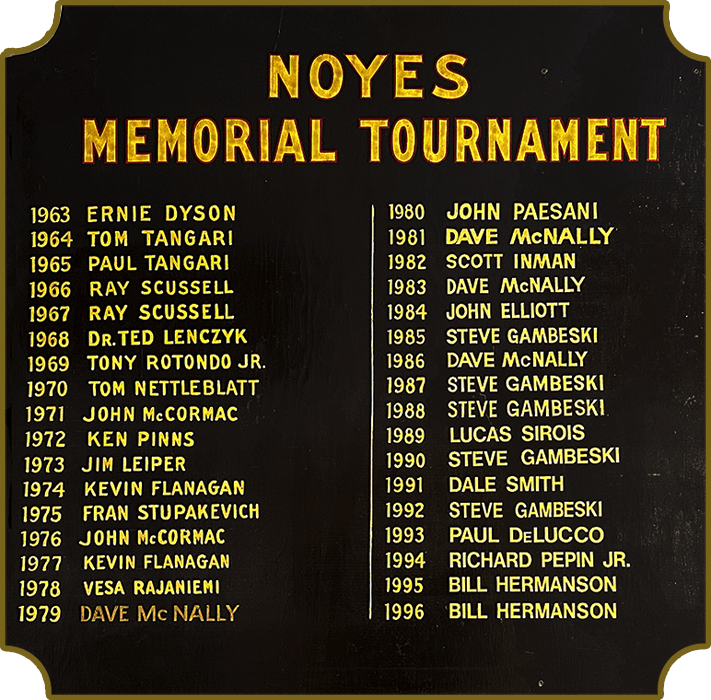
In 1962, 136 players again battled the heat, which had become a customary factor of the tournament. It was only fitting that the youngest player in the tournament would outlast the older players in this blistering heat. 16-year-old Dick Gesseck of Naugatuck, the State High School Champion, became the youngest player ever to win with a 2-and-1 victory over Charlie Piechowski, perennial Norwich Club Champion. Like many other great local players, Charlie Piechowski never won the Invitational.
The next year, Ernie Dyson became the third player in tournament history to win the title three times, defeating Phil Jones, another two-time winner, 2-up. It was also a sad year in Norwich with the resignation of long-time Norwich Professional, the likable Joe Donato.
Since 1940, no Norwich member had won the tournament, but in 1964 that was to change. In the semifinals, club member Tom Tangari pulled upset over Dr. Ted Lenczyk of Indian Hills to set up a final match with Hank Budney of Shennecossett. Tangari started poorly and was three down going to 11 when he began a tremendous comeback, which climaxed with a dramatic hole in one on the 15th. Budney was clearly shaken, and Tangari recorded a 2-and-1 victory.
In 1965, again, a Tangari took the title, but this time it wasn’t Tom but his 22-year-old son Paul. The younger Tangari recorded a 1-up victory over Tom Nettleblatt for the championship. Years later, Tom Tangari stated that he was much more nervous watching his son play for the title than he had been the previous year, when he played in the finals.
Former Yale University football great Ray “Scooter” Scussell took over the reins for the next two years as he defeated Dave Johnson of Meriden 3-and-2 in 1966 and the aging Ernie Dyson 6-and-5 in 1967. Against Dyson, Scussell shot a blistering 32 on the front and coasted home for his second consecutive title.
In 1968, Jim Lieper started the fireworks by shooting a practice round of 64. Lieper continued his torrid pace with a 68 to lead all qualifiers. But Lieper’s streak ended the next morning as he was upset by 17-year-old Roger Osterling. Two-time runner-up Dr. Ted Lenczyk picked up the slack and defeated John McCormac 2-and-1. The match ended abruptly as Lenczyk chipped in from 80 feet on the final hole.
1969 and 1970 were dominated by best friends from Avon, Tony “Skip” Rotondo and Tom Nettleblatt. In 1969, Rotondo defeated Nettleblatt 5-and-3, the third time “Big Tom” had lost in the finals. But in 1970, Tom reversed the previous year’s outcome with a sudden-death victory on the 19th hole.
Over the next few years, the overall entries in the tournament dropped drastically due to conflicts with other state tournaments and deteriorating course conditions. Although entries were down, the better golfers in the State were still competing. In 1971, John McCormac defeated Jim Griffith of Hartford 1-up to record his second victory.
In 1972, virtually unknown Ken Pins of Sun City, Arizona, mesmerized the field with his spectacular play. He defeated John McCormac 2-and-1 in the finals. The next year, Jim Lieper of Norwich proved to be the best as he handled Billy Wilson of Pautipaug 7-and-6. Through 12 holes, Lieper was 4 under par in a steady rain.
The first year that four players from Norwich reached the semifinals was 1974. In one match, Kevin Flanagan topped defending champ Jim Lieper 3-and-2, and in the other, Paul Tangari defeated Dan Stockwell in a grueling match, 1-up over 23 holes. 19-year-old Flanagan became the second youngest winner ever and only the fifth Norwich member to win the title as he defeated Tangari 2-and-1. The following year, Fran Stupakauich of Lyman Meadows positioned the ball marvelously all weekend and emerged with a hard-earned 2-and-1 victory over Norwich’s Paul Delucia.
Prior to 1976, only three players, Jim Oleska, Ernie Gerardi, and Ernie Dyson, had won the Invitational Title more than twice. That year, John McCormac took his place alongside the other tournament legends. When he copped his third title with a 2-up win over Vesa Rajaniemi of Brooklyn, Connecticut, and Willimantic Country Club, McCormac, with his “mechanical and methodical” style, has played in the finals more than any other player, other than Oleska. He was a decided threat every time he entered the tournament.
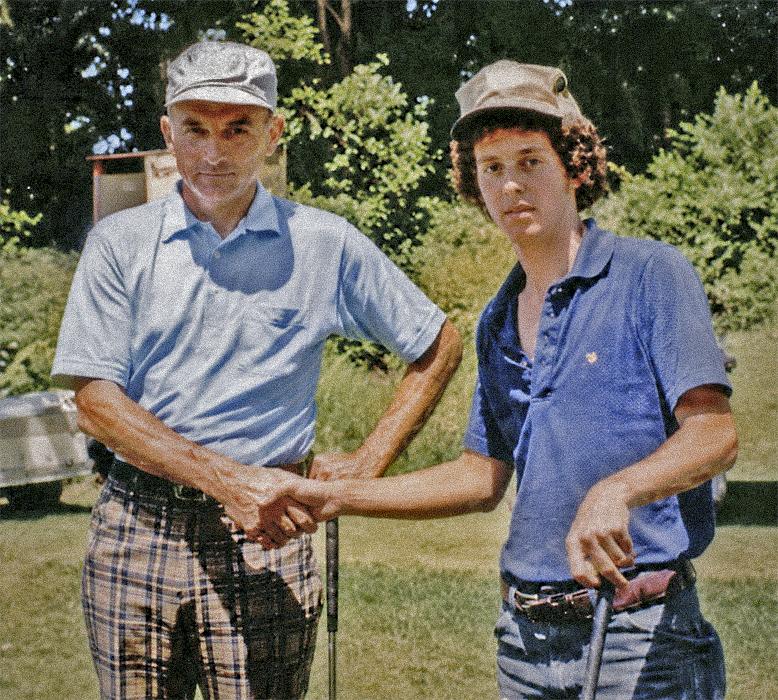
In 1977, history was again made as Kevin Flanagan became the only Norwich player to win the title more than once. In the semifinals, he trailed Paul DeLucia, one down, at the end of nine holes, but rallied to win 2-and-1. Flanagan showed his mastery of the Norwich course with an easy 5-and-3 victory over the 18-year-old John Paesani of the Willimantic Country Club.
Kevin Flanagan (right side of the photo) is shown shaking hands with Paul Tangari in 1977. Tangari won the Norwich Invitational in 1965.
In 1978, the City of Norwich purchased the golf course and began making full-scale improvements to the layout. An irrigation system, a maintenance shed, and a new clubhouse, which opened in the spring of 1983, were added to the course. Numerous improvements were also made to the course. New tee boxes were built, underbrush removed, and fairways and greens are finely maintained.
Throughout the 1970’s, the tournament took on a more local look. Many of the better players in the area began to take control of the championship. In 1978, Vesa Rajaniemi of Willimantic Country Club fought off a strong backside charge by Norwich’s Tim Burgess for a 2-and-1 victory. Rajaniemi became the first winner from Willimantic since Dow Ahern in the 1930’s. The scorching heat was again a factor throughout the weekend. In 1978, as in the previous year, local players dominated the tournament. Seven golfers in sixteen championship flights came from Norwich, but in the end, another player from the Willimantic Country Club prevailed. Dave McNally, a fine local amateur from Pomfret, charged into the finals with victories over former champions Paul Tangari and Kevin Flanagan before subduing Norwich’s Tom Finn in the finals 3-and-2. He carded 5 birdies before stopping Finn on the 16th.
1980 again saw Willimantic Country Club as the home of the winner. Young John Paesani started strong with a 68 qualifying score and never let up. Paesani was never contested throughout the weekend as he chalked up victories of 7-and-6, 9-and-7, and 4-and-3 before beating Dave Rossi of Torrington 7-and-6 in the finals. Paesani was an incredible 12 under par over the course of the tournament. In his semifinal victory over Vesa Rajaniemi, Paesani started eagle-birdie-birdie to quickly go 3-up, once again proving his dominance over the field.
In 1981, Dave McNally joined the group of two-time winners with a 2-and-1 victory. His long, accurate drives and fine short game proved to be the margin throughout the weekend. McNally would have been the fourth consecutive Willimantic Country Club member to win the tournament except that in 1981. He played out of Pautipaug Country Club.
The dominance by local players was broken in 1982 by a former Ledyard resident who relocated to Springfield, Virginia. Scott Inman, a 19-year-old player for Louisiana State University, returned to town to completely dominate the field. He culminated his weekend with a 5-and-1 victory over three-time champ John McCormac.
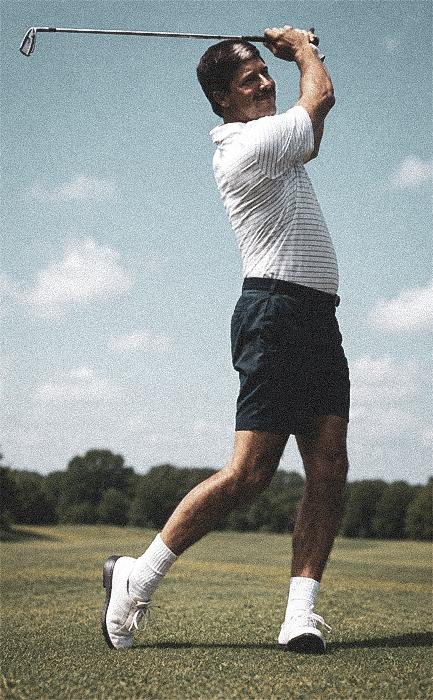
1986 ~ DAVE McNALLY WINS TOURNAMENT FOR A FOURTH TIME
Dave McNally, a member of the Quinnatisset Country Club in Thompson, Connecticut, won the Norwich Invitational four times: 1979, 1981, 1983, and 1986. He won the 1979 final tournament match when he was ahead by 4 holes with only 3 holes left to play. And, similarly, in 1981, he triumphed when he was ahead 5-and-4. However, the 1986 match play was a different story.
In the 1986 semi-finals, Dave beat the Norwich Golf Club member Paul DeLucia 5-and-4 and topped Waterbury’s Dave Rossi 2-and-1. But he struggled in the title match against Dale Smith. McNally lost the first three holes. In his interview, after the match, he said, “I’ve had enough experience to know there were 15 holes to play after I was down by three.”
After the first 11 holes, the match was even. Dave McNally birdied the 503-yard, par-5, twelfth hole while Smith scored a par. McNally maintained his lead. He was 1-up with 1 to play when he and Smith teed up on the 18th hole. McNally drove the ball onto the green, and Smith’s tee-shot landed in the sand trap, right of the green. After they both parred the eighteenth hole, Dave McNally was declared the winner of the 1986 Norwich Invitational tournament.
Dave’s brother, Gary, caddied for him during the match. After the match, Dave said, “I love golf, and I enjoy walking the course. Plus, it’s nice to have a part of your family involved. Those feelings you just can’t put into words.”
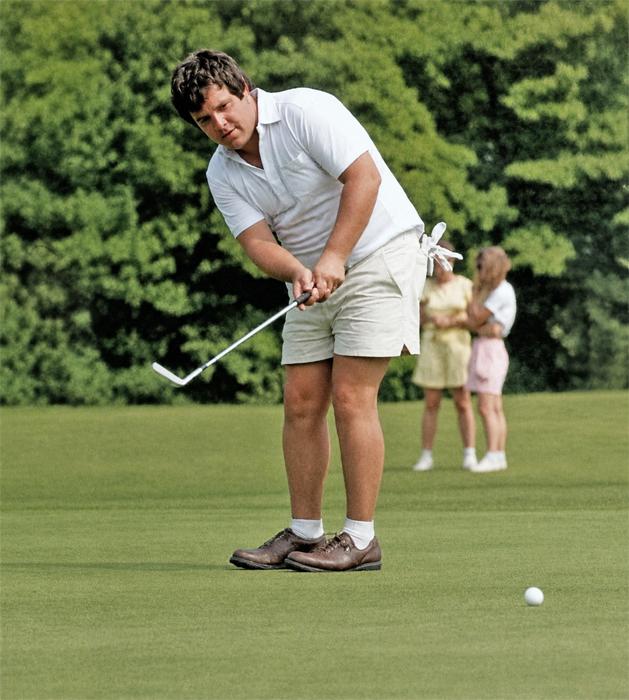
NORWICH GOLF CLUB MEMBER ~ STEVE GAMBESKI ~ 5-TIME CHAMPION
Steve Gambeski has won the tournament five times: 1985, 1987, 1988, 1990, and 1992. In 1988, at the 62nd Norwich Invitational, Steve brought the trophy home to the Norwich club.
1985: The First Championship
At age 22, Gambeski captured his first Norwich Invitational title by defeating Dale Smith 2-up in the final. He reached the final by defeating Kevin Flanagan 4-and-3 in the semifinals. In the championship match, Gambeski was 1-down after the front nine but rallied with key putts, including a 15-foot par putt on the 11th hole to take the lead and a 25-footer for birdie on the 13th to extend it.
1987: Sudden-Death Victory
Gambeski, then a 24-year-old electrician, secured his second title in a dramatic sudden-death playoff against defending four-time champion Dave McNally. After trailing by two holes through 14, Gambeski recorded five straight 3s to finish the round. He evened the match on the 16th with a 25-foot birdie putt and eventually won on the first extra hole by sinking a 15-foot birdie. Earlier that day, he had defeated Jim Homiski in the semifinals.
1988: Back-to-Back Titles
Gambeski became the first golfer since 1967 to win consecutive titles after defeating Vesa Rajaniemi 2-and-1 in the final. His path to the final included a semifinal victory over Dave McNally on the 16th hole. In the final, Gambeski overcame early putting struggles by connecting on a 25-foot putt on the 10th and a 15-footer on the 11th, maintaining his lead until clinching the match with a par on the 17th.
1990: Dominating the Field
After leading the qualifying round with a 68, Gambeski won his fourth title by defeating Dale Smith 5-and-4 in the championship flight final. He advanced to the final after a 4-and-3 semifinal win over Mike Harrington. In the championship match, Gambeski took command on the back nine, dropping a 15-foot birdie on the 11th and a 12-foot birdie on the 14th to secure the win and a $500 pro shop certificate.
1992: The Fifth Title
Gambeski earned his fifth championship by defeating fellow Norwich Golf Course member J.R. Pepin 3-and-2 in the final. He reached the final after a morning semifinal victory over Dale Smith, also 3-and-2. During the final, Gambeski opened a significant lead by winning three consecutive holes (5, 6, and 7). Although Pepin attempted a late-round rally, Gambeski’s consistency allowed him to tap in for the win on the 16th hole. He credited the victory to a pre-match “pep-talk” from his caddie and the immaculate condition of the course.
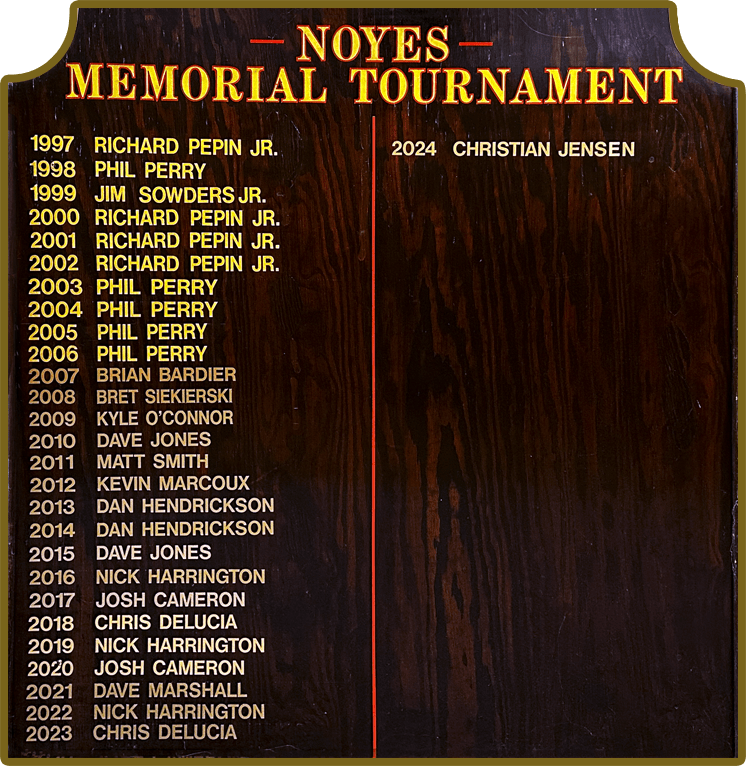
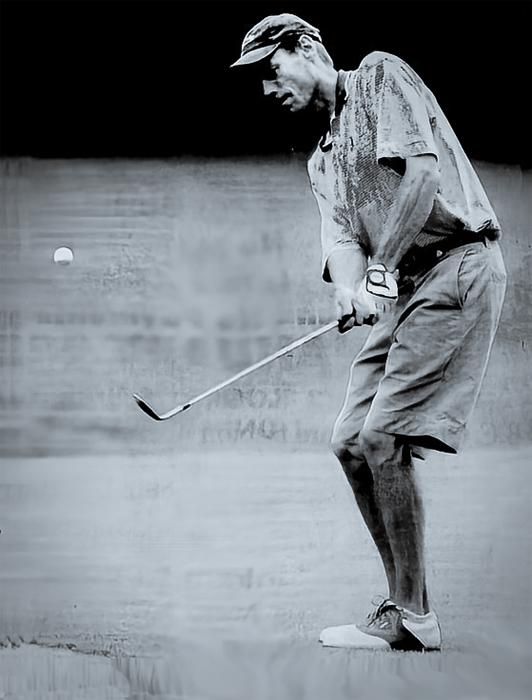
2006 ~ PHIL PERRY CAPTURES NOYES TROPHY FOR FIFTH TIME!
Phil Perry of the Black Hall Club in Old Lyme won the Norwich Invitational title five times (1998, 2003, 2004, 2005, and 2006). He is shown here chipping on to the 9th hole on Sunday, July 16, 2006. On that day, he beat five-time tournament champion J.R. Pepin. A humble man, he credited the work of his caddy and good friend, Jim West, in recently rebuilding his swing. At the time Perry said, “It was some fundamental things that most people don’t know that they have with their swing, because somebody else that knows what they’re doing looks at it.” In 2006, he defeated Bill Hanley of the Pautipaug Country Club (today’s Mohegan Sun Golf Club) in the final round 1-up.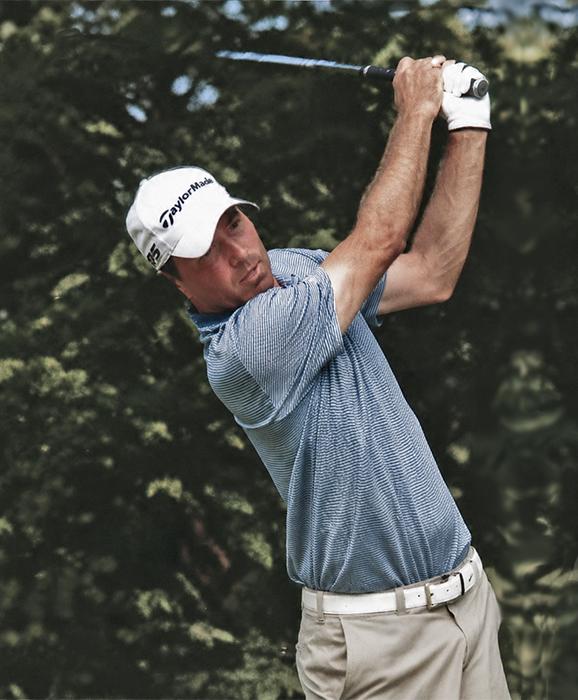
CHRIS DELUCIA WINS THE NORWICH INVITATIONAL 2018 AND 2023
Before winning his first Invitational, DeLucia had already established himself as a dominant local player, winning the Norwich Golf Club men’s club championship seven times.
Leading up to 2018, DeLucia, a former player at both St. Bernard’s High School and the University of Connecticut, had competed in the Norwich Invitational for 13 years. During that time, he reached the semifinals six times and the finals once before finally securing a victory.
2018 ~ The 92nd Norwich Invitational Title
DeLucia won his first Norwich Invitational championship, defeating two-time winner Bill Hermanson 4-and-3 in the final.
Chris entered the championship flight as the Number 15 seed after shooting a 73 in qualifying. His road to the title included victories over:
1) Defending champion Josh Cameron (2-and-1),
2) Todd Lavoie in the quarterfinals, where Chris rallied from a two-hole deficit with six to play to win on the 19th hole, and,
3) Rob Tedoldi (1-up) in the semifinals.
At the time of his 2018 win, Chris was serving as the Montville High School golf coach.
2023 ~ The 97th Norwich Invitational Title
DeLucia captured his second Norwich Invitational title, defeating Holden Sullivan 4-and-3 in the final round.
This tournament was unique as heavy rain in mid-July forced the final to be postponed for a month, with DeLucia eventually winning the match in August. He took home $800 for the victory.
His 2023 victory was an especially personal event for Chris because it was the first title match attended by his nine-month-old son, Theodore, while his father, Paul, served as his caddie.
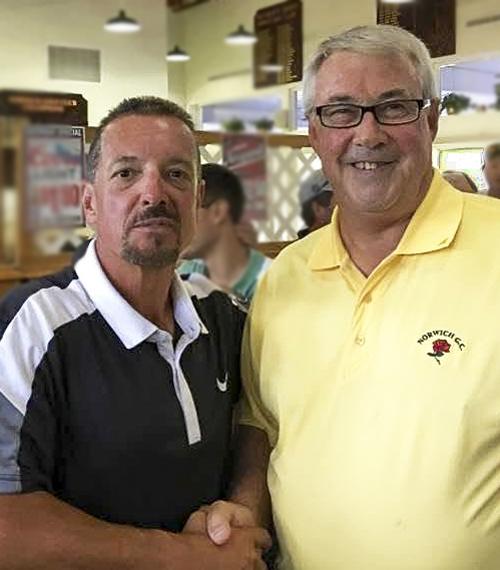
Steve Gambeski is shown here, along with Jeff Doerr, in 2017 after winning the club championship. Jeff Doerr was a teaching professional at the Norwich Golf Course from 2012 to 2020. Steve holds the record for the best-every round at today’s Norwich Golf Course!
Chris DeLucia, another Norwich local golfer, won the Invitational Tournament in both 2018 and 2023. He also captured his Club Championship FOURTEEN times – the most in the history of the Norwich Golf Course. Chris also has two Lake of Isles Championships. His career best round is 63, which at that time was a course record
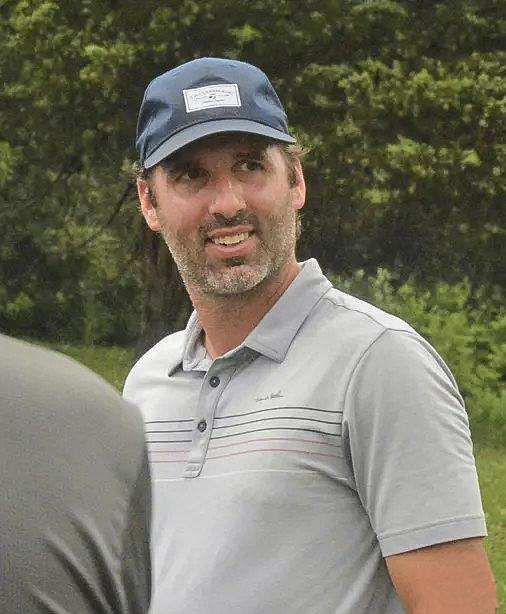
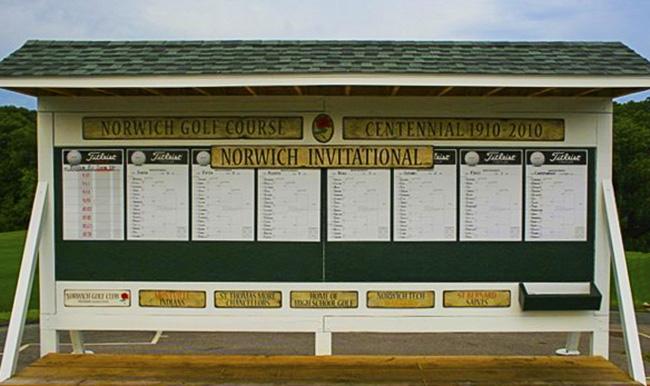
In 2010, the Invitational celebrated the 100th Anniversary of golf being played at the Norwich Golf Course. Dave Jones won the tournament both in 2010 and 2015.
On July 17-19, 2026, the 100th annual Norwich Invitational was played again. It is the second-oldest running amateur tournament in Connecticut. Each year, 172 top amateur golfers try to qualify for weekend match play competition. Friday consists of 18 holes of individual stroke play for qualifying and seeding.
The top 96 golfers are then organized into corresponding flights and assigned seeding positions based on their scores. Saturday, there are 2 rounds of match play to narrow down the field. Sunday features semifinal matches and final matches for all flights. Also, on Sunday morning, the optional “Beaten 8’s” medal play event for those who lost their 1st round matches.
The tournament remains the showcase of Eastern Connecticut Golf Tournaments. This fine tradition will most certainly continue for time immemorial.
History of the Norwich Invitational Tournament Slide Presentation
*Click the 3 vertical dots to enter fullscreen mode or change speed
1983: Researched, compiled, and edited by Danny Stockwell, John Pszyk Jr., and Al Kivlin
2026: Updated, researched, and edited by Bob Dees
