History of the Norwich Golf Club
This Scrapbook Contains a Variety of Norwich Golf Club Memories and Events that Illustrates the Unique Nature of Our Club and Course
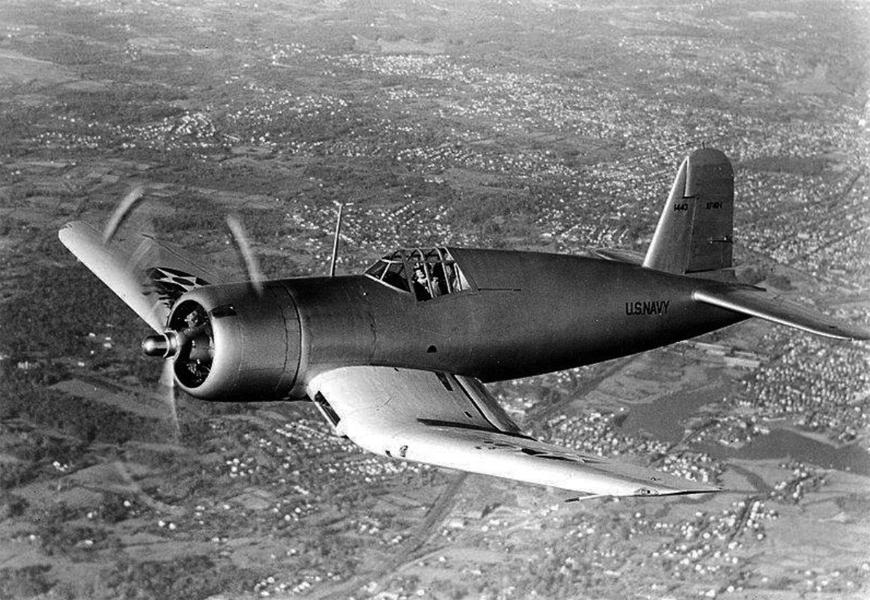
Experimental World War II Fighter Plane Lands on Norwich Golf Course
Countless people have visited the Norwich Golf Club over the years, but no visits have been quite so dramatic as Boone T. Guyton’s, a U.S. Navy aviator and experimental test pilot, who dropped in for an unexpected visit on July 11, 1940.
By January 1940, tensions were rising worldwide due to the war in Germany. The U.S. had not yet declared war, but the American military infrastructure was building at the Vought-Sikorsky airplane factory in Stratford, Connecticut. They were in the final stages of development of a high-speed, single-seat fighter, the XF4U-1. (“X” stands for “experimental” and “-1” stands for first generation). The production version later became the famous F4U Corsair.
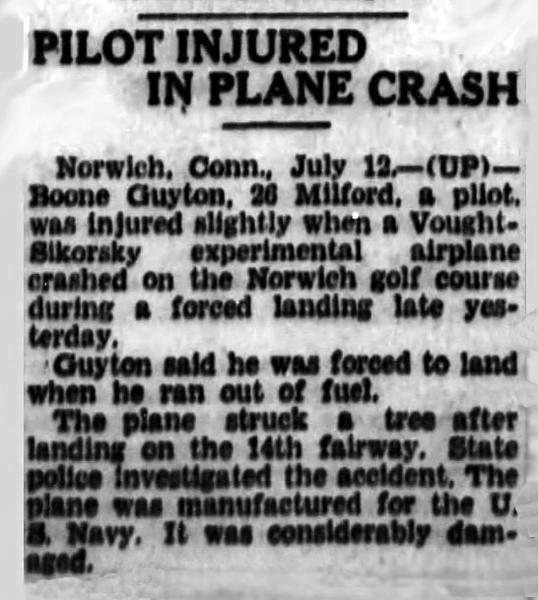
July 12, 1940
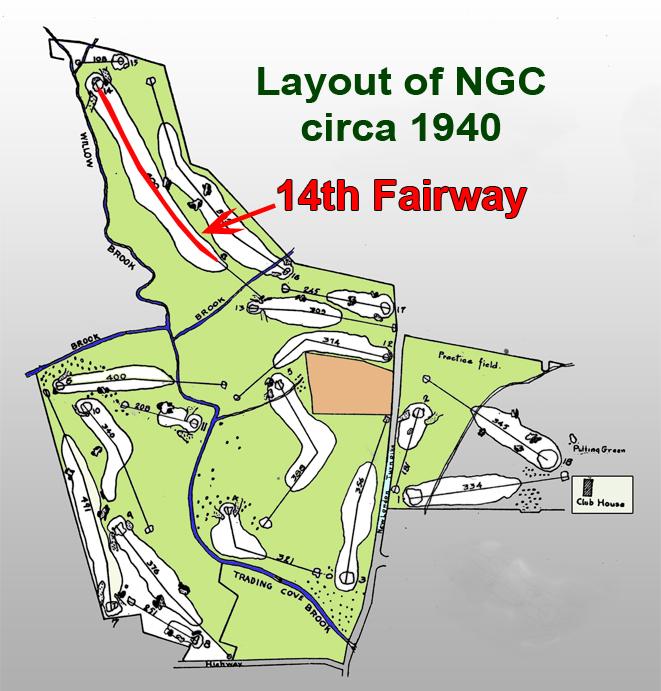
On July 9, Guyton flew an XF4U-1 for the first time. On his fifth flight in the plane, July 11, 1940, Guyton was caught in foul weather during high-speed testing, and the Corsair ran out of fuel. As he was flying over Norwich, he most certainly noticed the 14th fairway of the Norwich Golf Course. In 1940, the 14th hole was the course’s longest at 600 yards. The fairway is today’s 12th hole and one of only three par 5 holes. It must have been clear to Guyton that the 14th fairway was more than long enough to safely land the plane.
The grass was wet and slippery, but Guyton had little choice. He skidded the Corsair down the fairway, hit a tree, and flipped over. The plane was damaged considerably, but Guyton was only slightly injured. The Connecticut State Police investigated the accident.
Luckily, the damage was repairable and only set the program back by two months.
Voight-Sikorsky demonstrated the XF4U-1 to the Navy on October 1, 1940, becoming the first single-seat production fighter to surpass 400 mph. The US Navy was very pleased with the Corsair’s performance and, in June 1941, ordered 584 copies. Over the next 11 years, that figure grew to over 12,500 F4Us.
*Place your cursor over the map to magnify
1975 Golf Match
Golfers have enjoyed playing in Norwich for generations. This video shows several local golfers, Joe Mullroy, Joe Kozel, Carl Girasoli, and Biff Sabitino playing the “old” Norwich Golf Course in 1975.
Click the triangle in the bottom-left corner of the photo to play this nostalgic video.
Click the small speaker icon on the right side to hear the music.
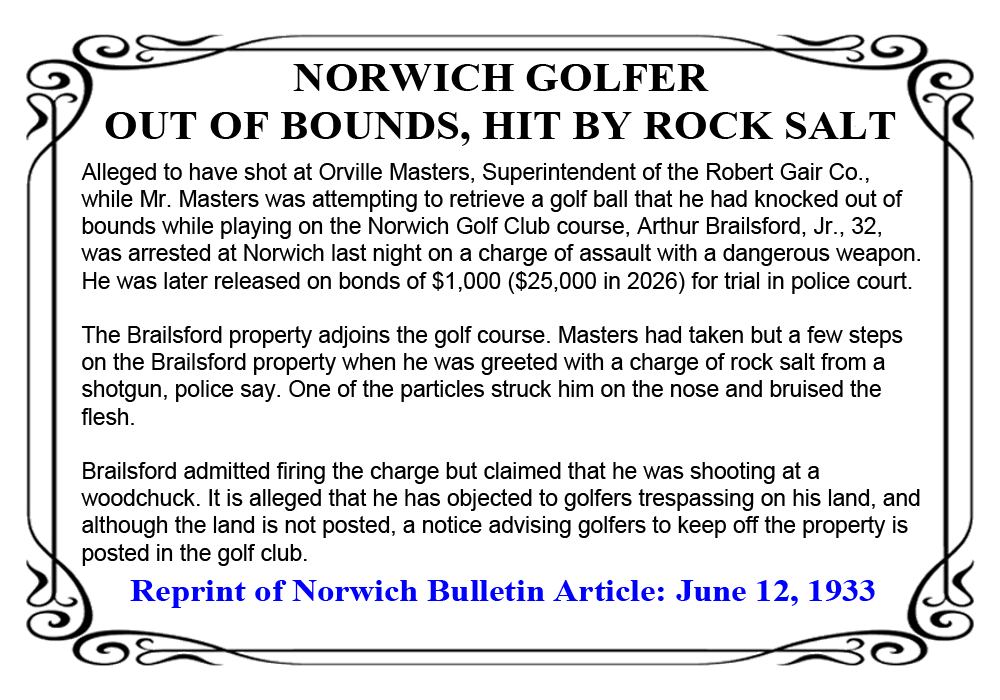
GOLFER STRUCK BY ROCK SALT
Playing golf on the Norwich Golf Course has been an enjoyable pastime for thousands of people for more than 100 years. However… sometimes things do not go the way one would hope.
On June 12, 1933, Orville Masters was finishing his round, playing the last hole (today’s 16th hole). Unfortunately, his ball strayed left, went out of bounds, and landed on Mr. Arthur Brailsford’s property.
After Mr. Masters stepped onto Mr. Brailsford’s lot, he was greeted by a charge of rock salt fired from a shotgun. Later, Mr. Brailsford told police that he was aiming at a woodchuck.
A reprint of the full article is shown here.
THE OLD WATER TANK
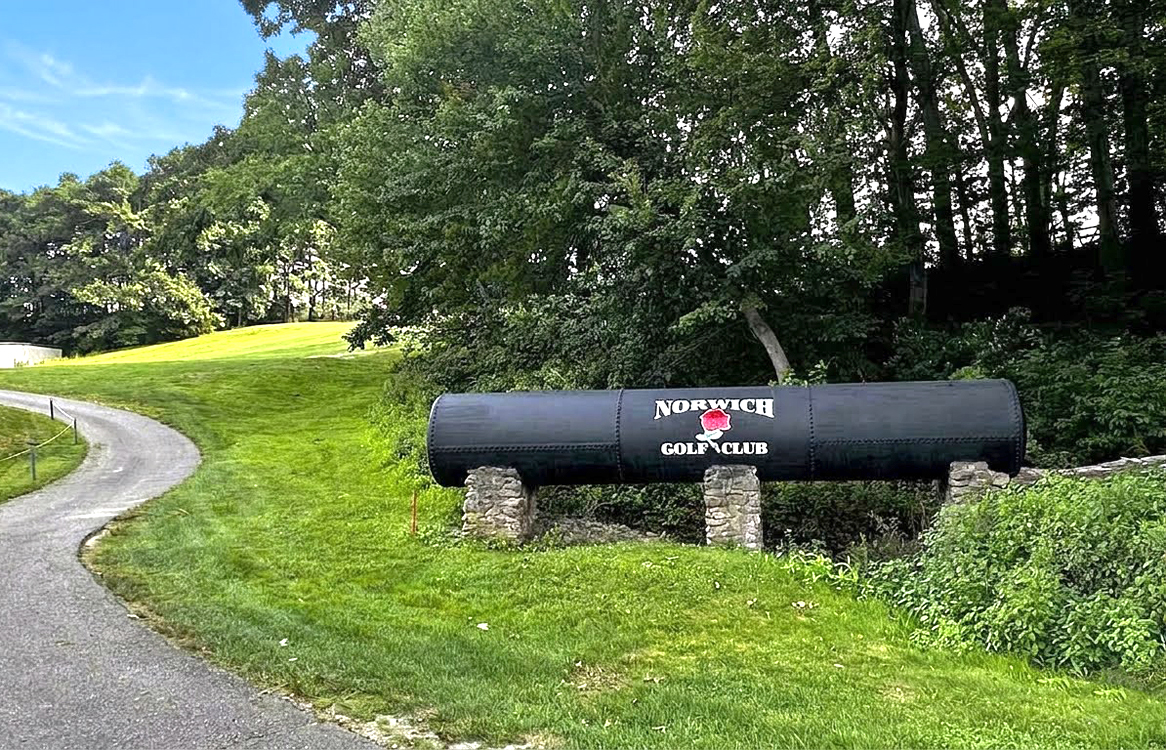
There is an ornamental water tank that sits today’s third green below. However, in times past, the tank was not simply ornamental. It was used to irrigate the course and became a source of fresh water, from which Norwich residents could take a drink or fill their water bottles. It was a popular public facility for many years. But …..
The brook that fed the tank was also used by local wildlife. Animals drank their fill, perhaps bathed in it, and most likely relieved themselves near the brook’s edge. When open forests became more scarce due to new buildings, more animals naturally flocked to the brook. These practices resulted in Giardia germs spreading throughout the water, leaving water that caused many people to have short-term but severe intestinal problems.
In the late 1980s, in the interest of public health, the tank was closed to the public. It is no longer used for irrigation or public use, but it still stands today as a reminder of years past.
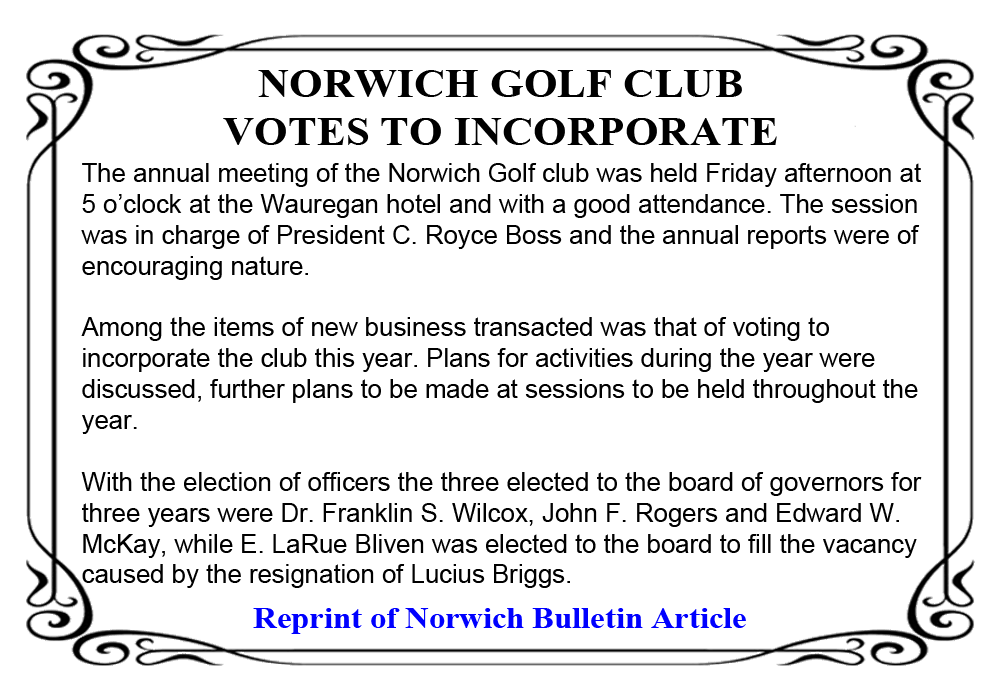
NORWICH GOLF CLUB INCORPORATED ~FEBRUARY 1927
Although the first Norwich Golf Club was organized in 1903, today’s club was officially incorporated during the third week of February 1927.
The article shown here is a reprint of an original newspaper article printed in the Norwich Bulletin on January 22, 1927. It states that the club voted to incorporate on Friday, January 21, 1927.
The article identifies C. Royce Boss as the club’s President and three elected officials, Dr. Franklin S. Wilcox, John F. Rogers, and Edward W. McKay.
NOTE: Image does not depict any real people or event

BEST ROUND PLAYED AT NORWICH GOLF COURSE
Over the past hundred years or so, there have been many course layouts. The record for the latest 6,228-yard course best round was set by Steve Gambeski.
September 7, 2015, was an historic day for Steve, his golf partners George Dumas, Red Sowders, Pete Gilman, and the Norwich Golf Club. Their round began with a “ho-hum” bogey for Steve and George, and a par for both Red and Pete.
But Steve’s below-average start did not bother him too much because by the end of the front nine, he was 4-under par. And, by the end of the round, his score was an amazing 9-under par. Steve’s round has stood as the course record for more than 10 years.
Everyone should remember that a slow start could end in an historic round!!
On August 8, 1987, Ellsworth “Ellie” E. Chase Jr. set the course record of 10-under par. His round was played on the Norwich Golf Course, which was configured differently from today’s course.
GEORGE FALCONER & THE FIRST GOLF SCHOOL IN NORWICH
George Falconer served as the golf professional for the Norwich Golf Club during the pivotal transition from a nine-hole to an 18-hole course in the mid-1920s. His contributions spanned instructional innovation, operational support, and record-setting athletic performance.
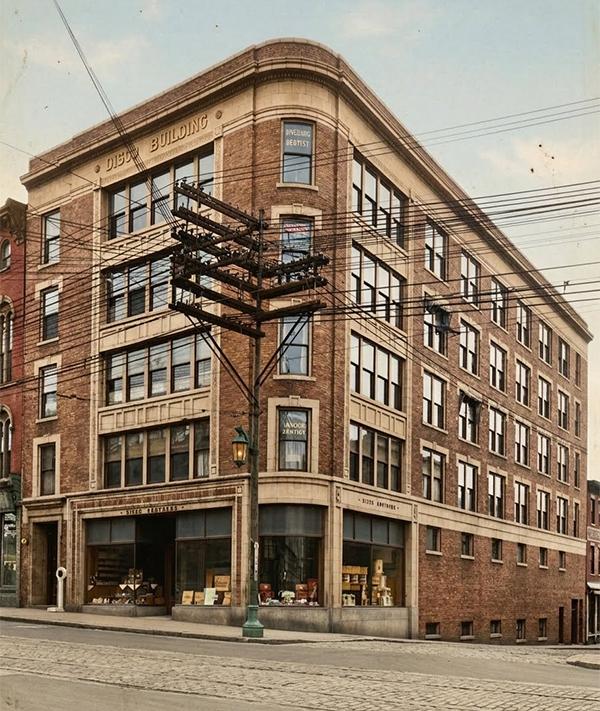
In January 1924, Falconer introduced an innovation for Norwich by opening an indoor golf school on the first floor of the Disco Building.
- Facility Details: The school consisted of two rooms: one fitted with a putting green designed to mimic “real velvet green” and another with a large net for driving and iron shots. Players hit off fiber mats that simulated real turf.
- Community Impact: The school was described as a first for the eastern part of the state, allowing members to keep in trim and beginners to learn the game during winter months when outdoor play was impossible. By March 1924, reports indicated that at least 42 golfers were benefiting from these indoor lessons.
The Disco building was built by brothers Samuel and Morris Disco on the corner of Main and Ferry Streets in Norwich. It housed Falconer’s golf school, and later became home to First National Store, then Norwich Savings & Loan, now Eastern Connecticut Savings & Loan.
Falconer demonstrated strong loyalty to the Norwich Golf Club by declining an invitation to become a professional at a club in Savannah, Georgia, choosing instead to remain in Norwich for the 1924 and 1925 seasons. He was a central figure in the formal opening ceremony of the new 18-hole links on the morning of July 4, 1925. His duties included preparing the course for the season and coaching members to improve their general play.
As a player, Falconer set the standard for the newly expanded 18-hole course:
- Initial Record: He held the early course record of 80.
- Breaking 70: On August 3, 1925, Falconer shattered the course record by shooting a 69, marking the first time anyone had broken 70 on the new layout.
- Championship Caliber Play: His record-setting round included being three under par on the first nine holes, featuring birdies on the 1st, 3rd, 7th, 8th, and 17th holes. His performance was described as being of “championship caliber,” with remarkable putting and approach shots that often landed within a foot of the pin.
George Falconer was one of the pioneers of golf in Norwich
SUICIDE HILL: THE THRILL OF THE HILL
For generations, as soon as the first heavy snow blankets the Rose City, a familiar migration begins toward the Norwich Golf Course. At the heart of this winter tradition is the legendary “Suicide Hill,” a steep, split-level stretch located on the second hole that has long been considered a premier sledding destination in Southeastern Connecticut.
People flock to Suicide Hill for the adrenaline rush of its sharp descent. Sledders sail down a long, steep stretch, level out briefly on a plateau, and then “catch a little air” as they continue their plunge toward the bottom. For local families, it is a time-honored tradition; parents who raced down the slopes as children now bring their own sons and daughters to experience the same thrill. On busy Sunday afternoons, the parking lot is often as full as it is during the height of the summer golf season.
Generally, the city treats sledding as a public privilege rather than a sanctioned activity. While the Norwich Golf Course Authority recognizes the hills as a “great resource” and has historically been reluctant to shut them down, they do not formally “sanction” the activity due to insurance risks.
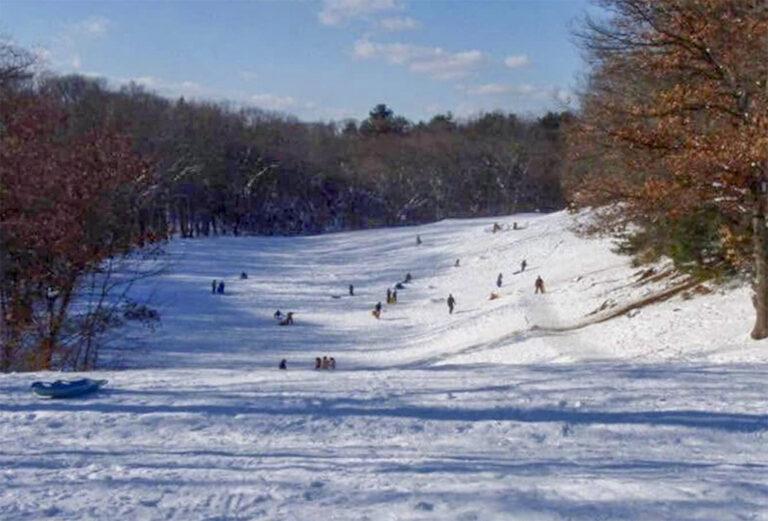
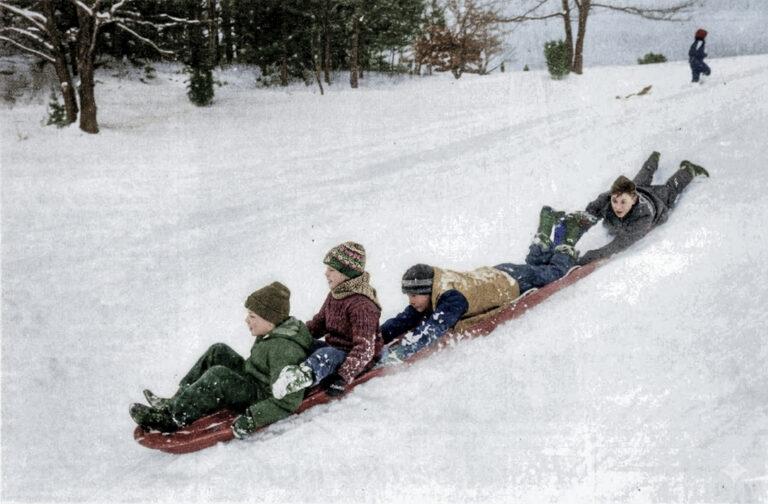
At various times, the hill has been declared strictly off-limits. As of 2021, while most of the course is open to the public for winter recreation, signs explicitly prohibit sledding on the second hole (Suicide Hill) due to its dangerous proximity to Trading Cove Brook.
During periods of high injury rates, the city has used police patrols and physical barriers such as logs, brush, and felled trees to deter thrill-seekers.
A Year-by-Year History of the Hill
The documented history of Suicide Hill reflects a constant tug-of-war between community tradition and safety concerns:
Late 1970s: During the course’s transition to municipal ownership, Chairman Barney Caulfield advocated for formalizing winter use. In November 1978, he proposed a ski trail to augment the “wintertime sliding areas” that had been open to residents since the Dawson family owned the property.
1984: The hill was recognized in an informal survey as one of the area’s top spots, though it was then often referred to as “Deadman’s Hill.” Police noted it was “fairly safe,” though parking on the New London Turnpike was a major issue.
In addition to Suicide Hill, there is a “bunny hill,” shown below, very near the parking lot and first fairway. This 2026 video, with the Norwich Golf Club clubhouse in the background, shows a very small portion of the attraction.
1987: A “black year” for the hill. After five or six people were injured in a single Sunday, the Norwich Golf Course Authority banned sledding and posted warning signs. The hill had become like a sheet of ice because many sledders used saucers that packed the snow into sheets of ice. Sledders reportedly disregarded the signs and even removed logs and brush placed on the slope to block them, leading to threats of arrest for trespassing.
1995: The atmosphere had shifted back to cooperation. Course Supervisor Bruce Morse admitted that staff plowed the parking lot specifically for sledders, noting, “As soon as the snow hits they flock here”.
2004: Safety concerns resurfaced. The hill was again barricaded with cut trees, much to the frustration of local sledders who still considered it “truly the best hill around.”
2015: A new threat emerged: trash. After a weekend storm, residents found the hill littered with broken plastic sleds and debris. Despite maintenance concerns, the Authority confirmed that “trash won’t shut down sledding,” reiterating their commitment to keeping the course available for traditional winter use.
2021: The current era is defined by warning signs. While the rest of the holes remain open to the public, Suicide Hill is officially marked with signs prohibiting sledding because it is “steep and drops off quickly to a stream.” However, Superintendent Eric Kundahl noted that “thrill seekers” continue to ignore the signs for the sake of the legendary run.
Ultimately, Suicide Hill is far more than just a steep slope on a golf course; it is a cherished symbol of community spirit and winter joy for the people of Norwich. While formal policies and warning signs have evolved over the decades to enhance safety, the core of the story remains a positive, long-standing tradition that brings generations of families together to “catch a little air” and experience premier sledding in eastern Connecticut.
From the early advocacy of leaders like Barney Caulfield to modern efforts by residents to keep the slopes clean, the hill represents a vibrant public privilege maintained through mutual respect and a shared love for the land. As long as the snow falls on the Rose City, the laughter echoing off the second hole fairways ensures that Suicide Hill remains a legendary and enduring part of the course’s multi-use legacy.
DID YOU KNOW THAT ….
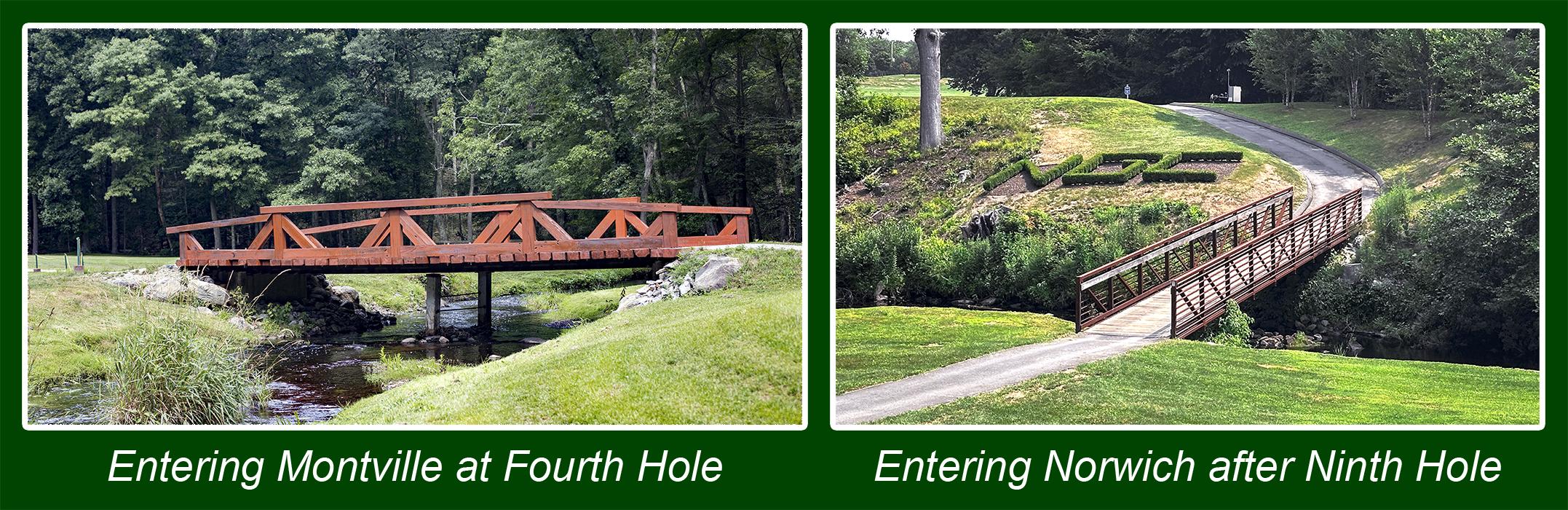
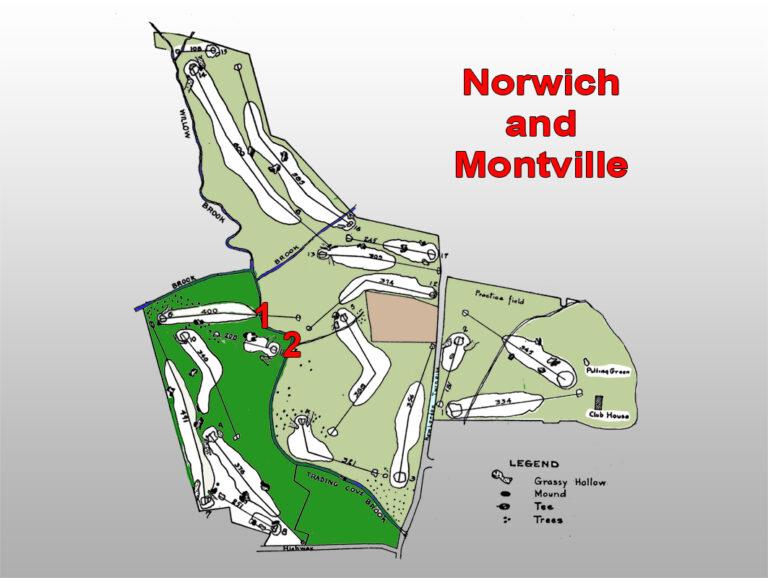
Did you know that approximately a quarter of the land upon which the Norwich Golf Course sits is in Montville? The southwesternmost portion of the Norwich/Montville boundary is separated by Trading Cove Brook. The lower, darker-colored portion of this map identifies the Montville section of the course.
On the fourth hole, once golfers cross the bridge shown below at location 1 marked on the map, they are in Montville. Once they complete the 9th hole, they return to Norwich via a bridge at location marked 2.