History of the Norwich Golf Club
1888 SIX-HOLE COURSE
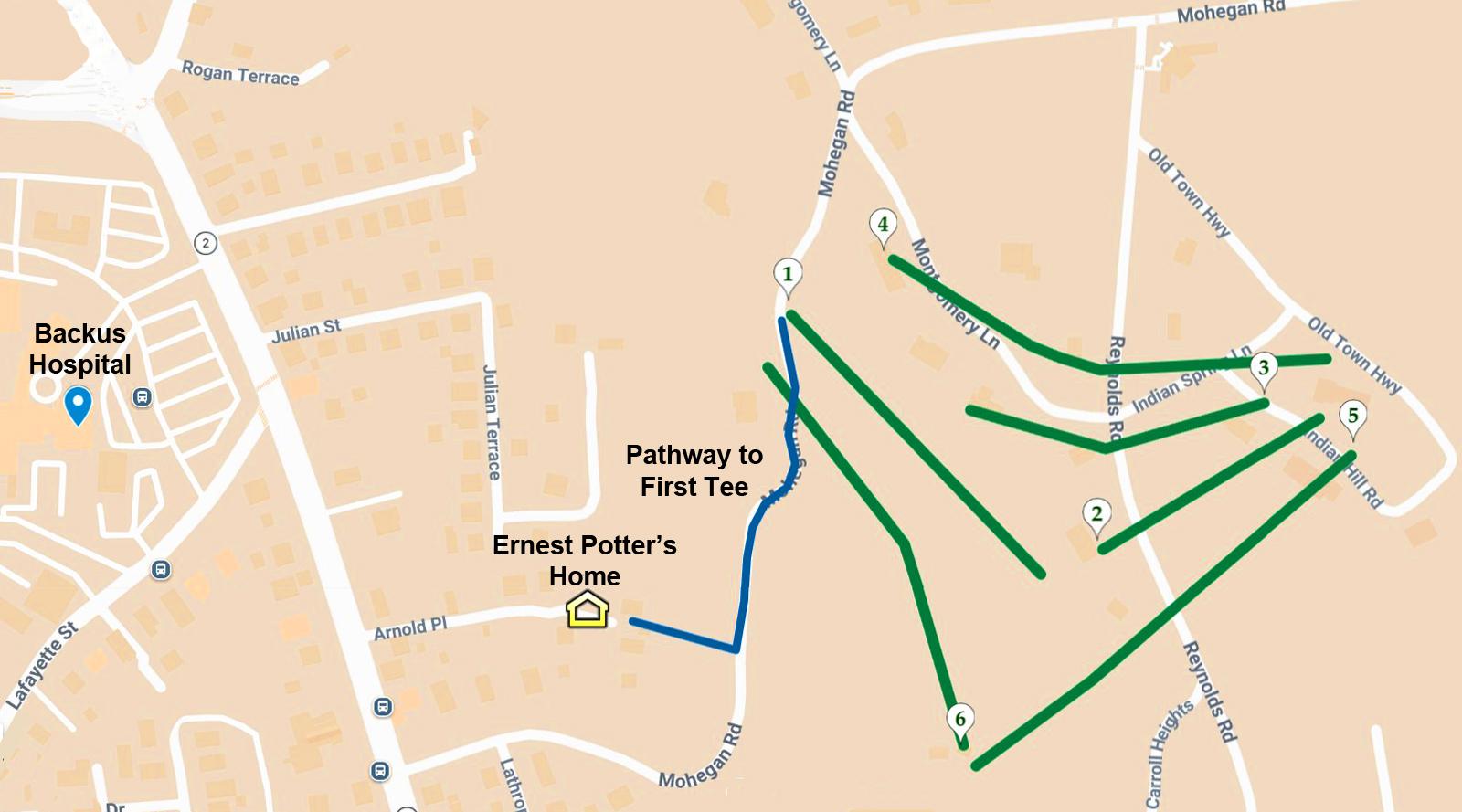
The first golf course in Norwich was located behind the former home lot of Benedict Arnold’s family. Ernest Felix Potter and one of his young golf enthusiasts laid out a 6-hole golf course beginning in 1888. Mr. Potter was the choir master of Norwich’s Christ Episcopal Church, and Norwich’s early golfers consisted of Potter and his choirboys, who were given both golf and vocal lessons. This 6-hole course configuration was used for approximately three years.
The United States Golf Association (USGA) was founded in December 1894, six years after this 6-hole course was established. The USGA’s first officially recognized golf club in Connecticut was the Fairfield Country Club, today’s Greenwich Country Club, in 1892.
Norwich’s 6-hole layout was a “links” style golf course. A links course is the oldest style of golf course, first developed in Britain. The word “links” comes via the Scots language from the Old English word “hlinc,” literally meaning “rising ground, ridge.” The term refers to an area of coastal sand dunes and sometimes to open parkland.
The beginning and end of the course were both located adjacent to Mohegan Road, about 300 yards from Mr. Potter’s home. The map pins shown here indicate the approximate locations of the six tee boxes and the links. The location of the first link is described and shown on a map that was published in the Norwich Bulletin on May 16, 1898. The locations of the other links shown on this map are approximate. They are based on the links printed on the Norwich Bulletin 1898 map.
It is interesting to note that the course had a ledge in one of its fairways. This ledge was used in Indian times as a place to grind corn, and the mortar holes were still visible.
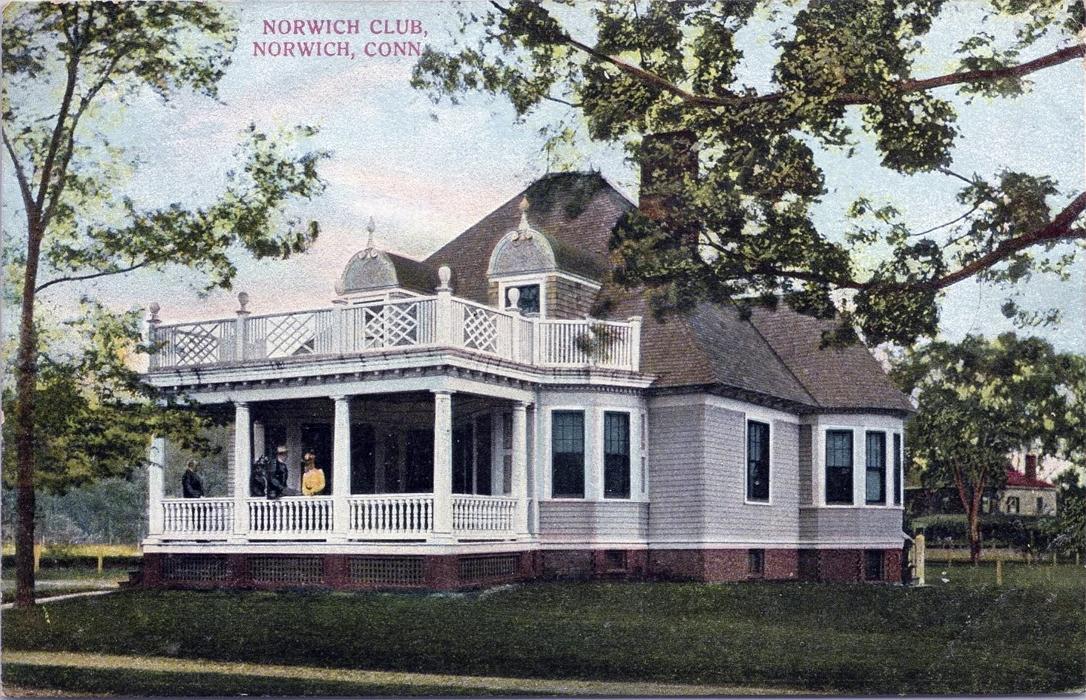
Norwich Club Clubhouse ~ circa 1907
NORWICH CLUB CLUBHOUSE
The Norwich Club was incorporated before May 23, 1895, and the clubhouse shown here was officially opened on January 28, 1896. By June 19, 1896, the Norwich Golf Club (a branch of the Norwich Club) had 33 members.
The clubhouse (a privately-owned home today) still stands at the corner of Crescent Street and Joseph Perkins Road. The Norwich Golf Club used the Norwich Club’s clubhouse, shown in the photo, as its base of operation.
The Norwich Club was a social club with a nearly equal number of male and female members. The club often hosted Sunday afternoon tea, formal dances, live plays, card games, and other social events.
The club was a gathering point for many of Norwich’s elite, and golf was one of the main attractions for many of its members. Many of the women members played golf; however, they often played five holes instead of nine.
1896 NINE-HOLE COURSE
A group of golfers from the Norwich Golf Club laid out a nine-hole course in the same general area as Ernest Potter’s first course sometime between 1888 and June 1896. The June 19, 1896, issue of the Norwich Bulletin discusses the course and its members, identifying 33 of them, 17 of whom were female. The president of the club was Reverend R.H. Nelson, and Mr. Ernest F. Potter was its secretary. The course was referred to in the Norwich Bulletin as the J. Milllar Wilson Links.
The connection between the golf course and Norwich’s Christ Episcopal Church in 1896 is notable. Reverend R.H. Nelson was the church’s rector; Ernest Felix Potter was the choir director; Mrs. J. Millar Wilson was the treasurer; and Mr. J. Millar Wilson was a member. It was also noted in the archives that several of Mr. Potter’s choirboys learned and played golf on the links.
The Norwich Golf Club’s first tournament was reported in the November 9, 1896, issue. The first place in the gentlemen’s division was won by Mr. John Reynolds, and the women’s division was taken by Mrs. J. Millar Wilson. Mrs. Wilson was the Treasurer of Norwich’s Christ Episcopal Church.
There is a silver cup engraved with the names, dates, and scores of the tournament’s winners.
| HOLE | DISTANCE | LENGTH |
|---|---|---|
| 1 | The Cup | 278 |
| 2 | Knoll | 260 |
| 3 | Brae | 270 |
| 4 | Dingle | 300 |
| 5 | The Weald | 347 |
| 6 | Bareacres | 210 |
| 7 | Dykes | 377 |
| 8 | Westward Ho | 513 |
| 9 | Home | 251 |
| Total | 2806 |
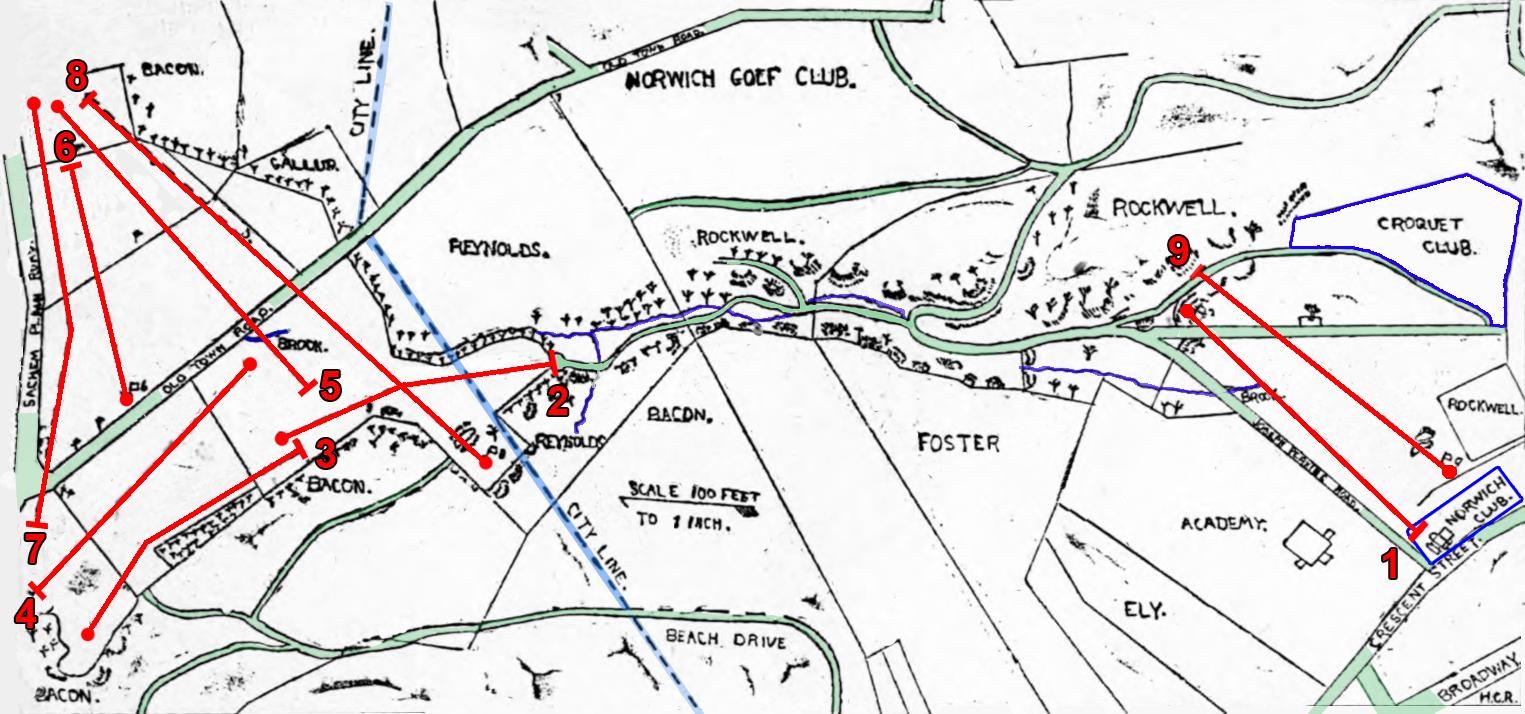
The first 9-hole Norwich Golf Club course was a links-style course, with every link given a unique name, as shown in the table above. The total length of the course was 2,806 yards.
In the bottom right corner of the map, you can see the location of the clubhouse relative to the Norwich Free Academy. The first tee box and the last hole were located near the clubhouse.
This map (without the colored highlights) was published in the Norwich Bulletin on May 16, 1898. The article gives a detailed description of the course and the names of the club’s officers.
It is interesting to note the proximity of the Norwich Croquet Club to the Norwich Club. The croquet court is shown in the upper-right corner of the map. Norwich was a national center for croquet in the late 1800s.
1898 NINE-HOLE COURSE
In early 1898, the Norwich Golf Club was 90 strong, and still a branch of the Norwich Club discussed above. A new layout of links of the Norwich Golf Club was formally opened by President J. Millar Wilson on May 16, 1898, in the presence of a large number of club members and invited friends. After the opening, a round was played, and Mr. Willis Austin won a trophy. After the contest, tea and punch were served in the clubhouse by several of the golfers’ wives. The club was flourishing and included many of Norwich’s elite citizens.
Shortly before the 1898 opening day, the Norwich Golf Club took up its quarters in the Norwich Club clubhouse. The membership of the two organizations (i.e., the Norwich Golf Club and the Norwich Club) was practically identical, and the interests of the two were practically united. However, the golf club maintained its own board of officers separate from the Norwich Club.
The Norwich Golf Club officially split from the Norwich Club and was formally organized on March 24, 1903
It is interesting to note the proximity of the Norwich Croquet Club to the Norwich Club. The croquet court is shown in the upper-right corner of the map. Norwich was a national center for croquet in the late 1800s.
1901 Course Description
*place cursor over image to magnify
It is noteworthy that the 1902 description mentions the Y.M.C.A. course that was also located in Norwich. There are many Norwich Bulletin articles that discuss the Y.M.C.A. course and the golfers who played it.
1901 NINE-HOLE COURSE
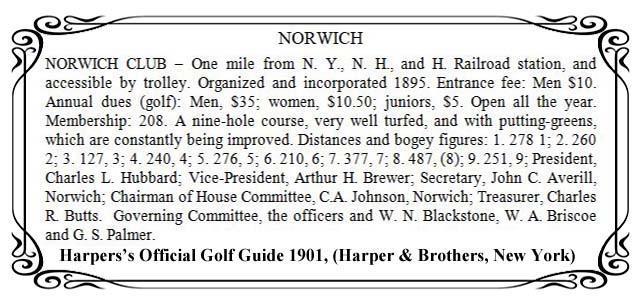
The “Harper’s Official Golf Guide 1901” article shown here states that the Norwich Club was incorporated in 1895 and provides details of Norwich’s 9-hole, 2,506-yard course. The club had a membership of 233 men and women.
Between May 1898 and July 1900, the course was shortened from 2,806 yards to 2,506 yards. The July 1900, Volume 7, page 64 issue of “Golf ~ An Official Bulletin of the United States Golf Association” describes the Norwich Club’s golf course.
The length is 300 yards shorter than the 1898 course described above. Upon comparing the 1900 table here to the 1898 table above, it is noted that the three holes with major changes were holes 3, 4, and 5.
In the club’s archives, there is a scorecard for a 2,707-yard course. The scorecard does not show what par was in use at that time.
The bogey system was the criterion of excellence. The back of the card is filled with local rules and penalties for lifting. A note at the bottom announces that hole number one has no local rule.
| HOLE | DISTANCE | PAR |
|---|---|---|
| 1 | 278 | 4 |
| 2 | 260 | 4 |
| 3 | 127 | 3 |
| 4 | 240 | 4 |
| 5 | 276 | 4 |
| 6 | 210 | 4 |
| 7 | 377 | 5 |
| 8 | 487 | 6 |
| 9 | 251 | 4 |
| 2506 | 38 |
Layout of Norwich Golf Club Course
July 1900
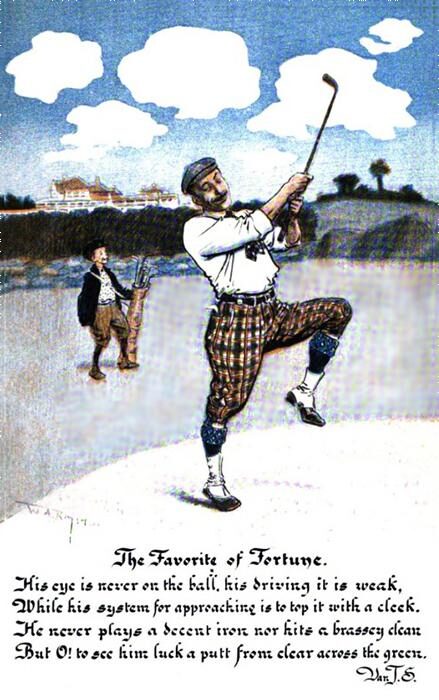
Golf Magazine ~ April 1900
1910 NINE-HOLE COURSE
A completely new, 9-hole course was laid out in 1910 on 80 acres acquired by the Norwich Golf Land Company for golf purposes, about three miles south of the city center. These 80 acres are part of the current course.
This locality was at some time… many years ago…a level plain, later to be eroded by the drainage of Trading Cove Brook and its tributaries. This erosion has left knolls, ridges, ravines, gullies, and the like…obstacles which make attractive and interesting hazards. The locality was once a favorite camping spot for the Mohegan Indians. The name Trading Cove Brook was derived from the fact that a nearby saltwater cove served as a trading point between the Indians and the Whites.
There is conflicting information as to who designed this course. In one instance, it is stated, “The course has been laid out practically as suggested by R.H Pryde of N.H.” [sic R.D. Pryde], a professional in charge of Yale Golf Club and New Haven Country Club. Later, it is stated, “The links were laid out by Willis Austin, with the assistance of R.D. Pryde, a professional from New Haven.” Similarly, several sources have published that the course was designed by Donald Ross. It is also rumored by others that the course was designed by Charles Blair McDonald. Folklore says that McDonald designed the course; however, the company he worked for wanted the Norwich Golf Club to pay an extra fee to have Mr. McDonald’s name attached to the course’s design. The mystery remains ….
There were many blind holes on this course, six out of the nine being blind…. two from the tee and four from the proper position to play the approach shot. The condition of the terrain in this area was much superior to the terrain of Norwich’s earlier courses.
LAYOUT OF 1910 NINE-HOLE COURSE BASED ON REFERENCES TO TODAY’S EIGHTEEN-HOLE COURSE
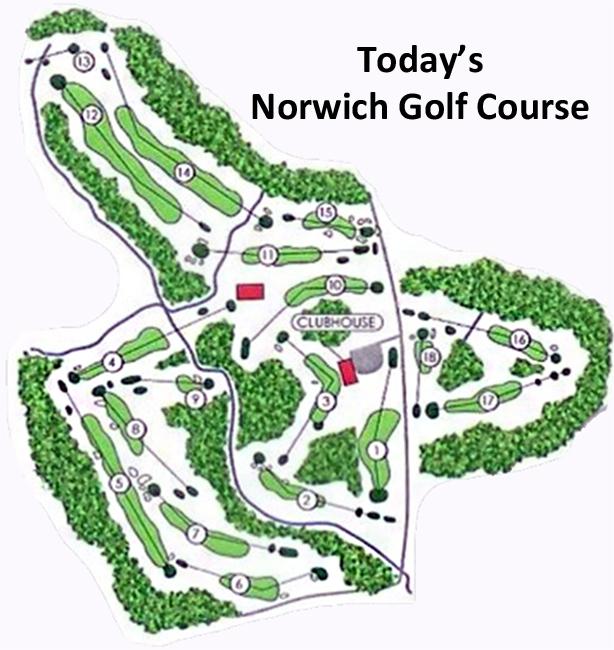
The following is a description of the holes in 1910. The descriptions are referenced to their current locations, as shown on the layout of today’s course on the left.
1st hole: Played backward on the existing 16th (current 16th tee being the green and green being the tee).
2nd hole: Played backward on the existing 18th.
3rd hole: The tee location is unknown. The green was to the left of the existing 3rd fairway at the bend near the bunker. The outline of the green can still be seen.
4th hole: Played from the old tee behind the existing 10th tee, across the brook to the left of the existing 9th green. The green was probably at the base of the hill leading up to the existing 8th tee.
5th hole: Played from a tee located near the existing short 8th tee (white tees) down through the gulley, across the existing 9th and 4th fairways to the green that was located in the wide area to the right of the existing 4th fairway, just after crossing the brook.
6th hole: Played from a tee that is still visible to the right of the existing 4th fairway, just as you start up the hill. The fairway went up the hill, probably crossing the existing 9th tee to the existing 7th green.
7th hole: Played from a still visible tee cut into the bank, partway down the slope, to the right of the existing long (blue tees) 8th tee. The tee shot crossed the brook to the existing 2nd fairway. Play continued backward on the existing 2nd fairway up the hill to the existing 1st green (Note: the green was redone in 2001). The pathways to the old tee and the one leading from the brook to the fairway can still be found.
8th hole: The tee is still visible on the rise to the left and just short of the existing 1st green. The hole was played to a green that was in the wide area to the left of the existing 3rd fairway, about 100 yards from the men’s tee (near the area of the current chipping green).
9th hole: Played backward on the existing 17th hole.
1925 EIGHTEEN-HOLE COURSE
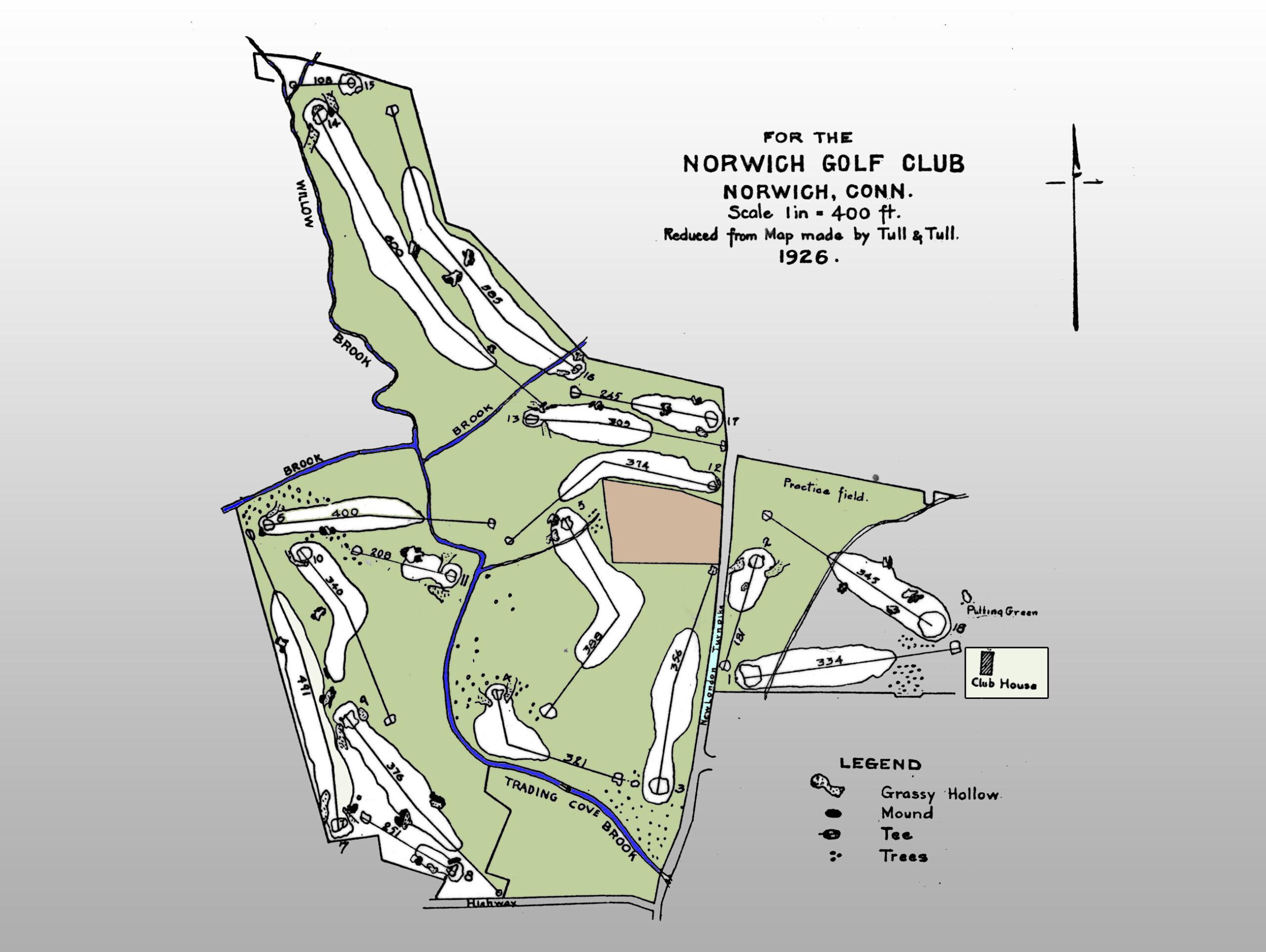
On March 12, 1924, the Governors of Norwich Golf Club authorized the Norwich Golf Land Corporation to purchase additional land. It was stated that the “land has been characterized by a celebrated golf course architect and constructor as the finest natural golf land he has seen in this State and the equal of any in the country.”
At that meeting, it was further reported “Blueprints of the proposed new layout gotten out by Tull & Tull, well-known golf architects, with whom is associated Walter J. Travis, veteran golfer and now designer of courses, were exhibited. If sufficient money is raised, Mr. Travis will polish off the plans; Tull & Tull, who are entirely competent to act, will do all the work.”
On April 19, 1924, the Norwich Bulletin reported that the course plans were changed and that new land was acquired, including the Connelly farm of 31 acres, 11 acres of the Elmer Pierson farm, and 18 acres of the James Allen farm.
The new plans were considerably different from the original plans. It is unknown whether these changes were due to the review by Walter Travis, to changes instigated by Tull & Tull, or to the Norwich Golf Club. Work started in May 1924.
Play continued on the 1910 nine-hole course during the early summer of 1924 as the new 18-hole course was being built. A temporary 6th green was used starting September 2, 1924. By September 13th, the fairways and tees had been seeded, and “Stolens” was used to seed the greens, which were completed by September 22, 1924.
Apparently, there was some restricted play on the course (possibly on the old greens or temporary greens) in the spring of 1925, since there were reports of match play at the course on June 2, 1925, and a ‘Memorial Day Program’ with special rules in effect due to the construction of the new 18-hole course.
Today’s 18-hole course opened Saturday, July 4th, 1925